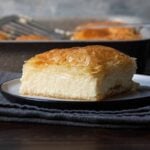
Galaktoboureko Recipe (Greek Custard Dessert)
Few Greek desserts make people smile the way they smile when they hear the word Galaktoboureko (Greek baklava is another one!). If you want to learn how to make the best galaktoboureko, the famous Greek custard dessert, just follow this easy, step-by-step recipe.
Servings: 16 servings
Calories: 428kcal
Ingredients
For the semolina custard cream:
- 5 cups whole milk see note #1
- ½ teaspoon salt
- ⅔ cup fine semolina see note #2
- 1 lemon the zest
- 1 ½ tablespoons vanilla extract or 1 capsule vanillin per Tablespoon of extract.
- 4.4 ounce white chocolate chopped optional, see note #4
- 3 medium eggs
- ½ cup white sugar
For the phyllo:
- 1 package phyllo pastry see note #4
- 1 cup clarified butter or ghee melted, see note #5
For the syrup:
- 2 cups white sugar
- 1 ¼ cups water
- 1 cinnamon stick
- 1 tablespoon lemon juice
Instructions
- Transfer the milk to a large pot and add the salt and the semolina while stirring with a whisk. Cook on the stove, over medium heat, stirring constantly until the semolina mixture boils. Remove from the heat.
- Add the lemon zest, the vanilla and the white chocolate and whisk to combine. Smell the custard and add more lemon zest or vanilla if needed, according to your preference.
- Transfer the eggs and the sugar to a medium bowl and whisk until frothy (you can also use a hand mixer for this). Whisking constantly, add the egg mixture to the semolina mixture and stir until combined. Cover with a lid and refrigerate until cold.✏️ Note: Adding the eggs after the semolina custard is cooked produces a soft, velvety cream filling. If you're used to to a filling with a thicker consistency, add the eggs from the start (at the same time as the semolina), also add 1 extra tablespoon of semolina and cook the custard until bubbly.
- Brush the baking pan with the melted butter and cover it with the two thirds of the phyllo sheets, in a way that the sheets overlap the dish. Brush each sheet of the phyllo pastry with melted butter before covering it with the next sheet.
- Pour the semolina cream filling over the sheets of phyllo dough.Also preheat your oven (top and bottom heat) at 350°F (175°C). If you only have a fan oven reduce temperature to 320°F (160°C).
- Fold the overlapping sheets over the filling, brushing each sheet with butter. Then, add the remaining sheets of phyllo and tuck any edges between the galaktoboureko and the baking pan.
- Gently score the surface of the galaktoboureko with a sharp knife, making sure that the knife doesn't cut all the way through the bottom of the pan (you only want to cut the top layers of phyllo).Sprinkle the surface with a bit of water (1-2 tablespoons, optional) and bake at the bottom zone of your oven, until golden brown, about 60-70 minutes.
- While the galaktoboureko is baking, transfer the sugar, the water and the cinnamon stick to a saucepan and bring to a boil. Simmer for 5 minutes, then add the lemon juice, stir well and set aside to cool.
- Take the galaktoboureko out of the oven and score with a knife following your initial cuts. Pour the syrup over the hot dessert. Let it cool completely before serving (the filling will seep out if you serve it warm).
Video
Notes
Recommended baking dishes:
- Rectangular 10x13.5 inches (25x35 cm)
- Rectangular 9x13 inches (23x33 cm)
- Round cake pan 12 inches (30 cm) in diameter
Nutrition
Calories: 428kcal | Carbohydrates: 59g | Protein: 7g | Fat: 19g | Saturated Fat: 11g | Polyunsaturated Fat: 1g | Monounsaturated Fat: 6g | Trans Fat: 0.003g | Cholesterol: 70mg | Sodium: 259mg | Potassium: 184mg | Fiber: 1g | Sugar: 40g | Vitamin A: 170IU | Vitamin C: 0.4mg | Calcium: 119mg | Iron: 1mg
